 +
+
An Amazon launch team may know the country where it wants to sell and assume that a creator's location answers the audience question. It does not. A creator can live in one place, publish for people elsewhere, attract a mixed public audience, or reach viewers whose buying conditions do not match the launch. Geography is important, but it belongs in an evidence record, not in an assumption. This research memo explains what to verify before a team turns a location filter into creator outreach.
Ten-second answer: Separate creator location, audience geography, product availability, shipping conditions, and launch priority. Public content can help form a question. It usually cannot confirm the full geographic case on its own. Record the evidence, name the gap, and ask the creator or the appropriate system for the missing fact.
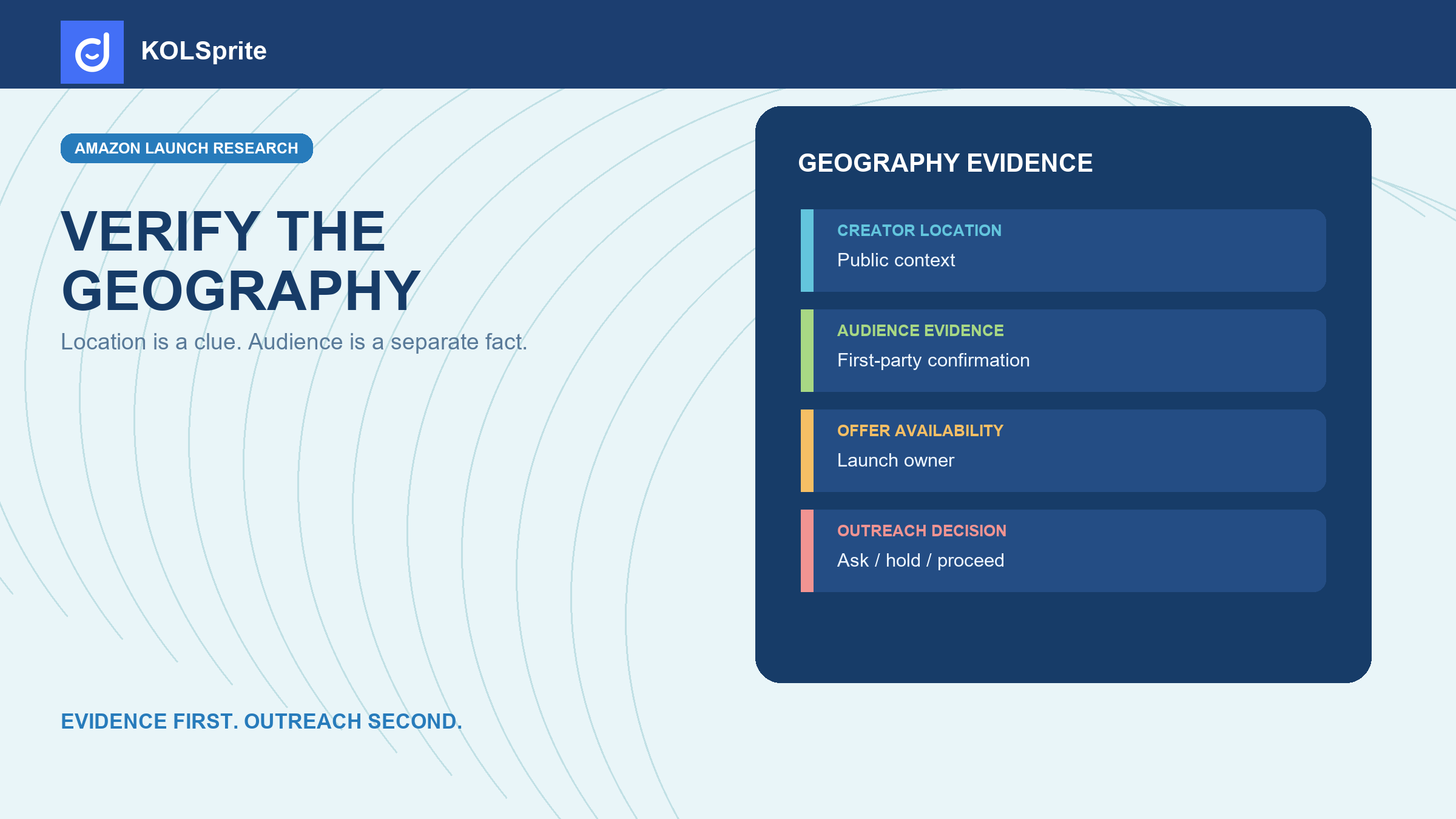
Location is often visible. It may appear in a profile, a caption, a shipping reference, a store link, a local event, or the setting of a video. Audience geography is different. It concerns where the people who receive and respond to the content are located. Product availability is different again. An Amazon listing may be live in one marketplace while a creator's audience is mainly in another. A launch can fail when the team treats any one of these fields as a substitute for the rest.
This distinction is not academic. It changes the outreach question. Instead of asking, “Is this a US creator?” ask, “Can this collaboration help us reach buyers who can actually access this offer, and what evidence supports that?” The second question may lead to a better candidate, a revised offer, or a decision to wait until the logistics match the intended audience.
The older KOLSprite page on finding TikTok influencers by location for Amazon launches is a useful starting point for discovery. This update goes further by treating location as one input in a geography evidence note, rather than the answer.
A geography evidence note is a small table with five fields: creator location signal, audience evidence, product-market availability, launch constraint, and open question. The point is not to create administrative overhead. The point is to stop the team from making a commercial promise based on a profile detail that may not matter to the buyer.
For example, a public video filmed in Toronto may support a cautious note that the creator appears to be in Canada. It does not confirm that most viewers are Canadian, that a US Amazon offer is relevant, or that a product can be delivered on the timeline mentioned in the content. Keep the statement as narrow as the evidence.
| Evidence field | Example of an observation | Appropriate use | What remains open |
|---|---|---|---|
| Creator location signal | Public caption refers to a local event | Prompt for a location question | Audience distribution and travel pattern |
| Audience geography | Creator provides a current first-party audience report | Use with permission in partner review | Whether it maps to the product offer |
| Product availability | Launch owner confirms the marketplace and fulfillment terms | Set the collaboration boundary | How the offer will perform |
| Viewer language | Recurring language in public content and comments | Shape a cautious creative question | Does not establish audience composition |
Evidence asset: Geography Evidence Note. Scope: public signals suggest questions for outreach. Only current first-party reporting and launch operations can confirm audience distribution and offer availability. See Amazon's seller site for the seller-owned launch surface.
Use KOLSprite to retain supported public creator context while your launch and partnership teams verify audience, offer, and fulfillment facts with the right owners.
Register and claim a three-day trial
Before researching creators, ask which geographic fact would change the launch decision. It might be marketplace availability, a delivery promise, language, currency, regulations, seasonal timing, or a customer support limitation. If no fact would change the plan, then a location filter may be false precision. The team may be better served by looking for a creator who can explain the product use case clearly.
If geography does change the plan, write the constraint in plain language. “US Amazon listing only; do not imply local delivery elsewhere” is clearer than “US target.” It helps researchers identify which public signals are relevant and helps the partnership team ask a respectful, direct question without making assumptions about the creator or their audience.
KOLSprite can help teams collect supported public creator and content context while they review the launch question in the TikTok browsing flow. A public caption, video setting, or comment thread can inform a research note. KOLSprite does not verify private audience geography, inventory, fulfillment coverage, legal eligibility, or Amazon sales. Those facts require the creator, the seller's operations data, or the relevant platform records.
A confidence score can make a weak geography assumption look neat. A source hierarchy is more honest. At the top are current first-party creator data shared for the collaboration and current operational facts from the seller. In the middle are public creator statements with dates and clear context. At the bottom are visible settings, language cues, and inferred location details. The lower levels can help you ask a question. They should not carry the commercial decision alone.
This hierarchy also protects the creator relationship. A concise note saying “Public context suggests a possible Canadian audience connection; please confirm your current audience geography and any relevant market restrictions” is respectful. It is far better than treating public posts as a hidden audit.
Current first-party creator information and confirmed offer availability align with the launch.
Public context is promising, but audience or fulfillment facts are missing.
The creator may suit the content job, but not the geographic launch condition.
The offer or marketplace is not ready, so creator outreach would create avoidable confusion.
Geography enters the brief through practical details. Does the product ship to the viewers being addressed? Are prices, measurements, language, or delivery expectations accurate? Does a local setting imply an availability claim? These questions belong with the people who own product facts and compliance. The creator brief should state the confirmed boundary, not ask a creator to invent a workaround.
For the broader creator selection work, the defensible creator shortlist guide helps keep public evidence beside open questions. For Amazon sellers deciding whether a social signal deserves inventory attention, the Amazon product research validation guide separates an interesting content signal from a stock decision.
A public clue cannot settle the creator's current audience distribution, whether a viewer can buy the item, the legal requirements for a claim, or the commercial value of a market. It cannot tell you whether a creator wants to work with Amazon sellers or whether a given launch will have product availability when the post goes live. Those limits should not stop research. They should define the next verification step.
That is the practical value of the note. It turns vague regional assumptions into a short list of facts that have an owner. The researcher gathers context. The partnership team asks the creator. The launch owner confirms the offer. Each person can do their part without claiming to know more than the evidence allows.
Join the KOLSprite Discord to discuss creator research limits, launch evidence notes, and respectful questions that avoid audience assumptions.
 +
+
Join the KOLSprite Discord community
The geography note should produce a question that is easy for a creator to answer and easy for the launch owner to use. For example: “For this US marketplace launch, could you share whether your current audience reporting shows a meaningful US audience, and whether any planned content would need a different availability statement?” The request is specific, it explains why the fact matters, and it does not ask the creator to guess.
Prepare the question while the public context is still open. That is when the team can see which observation triggered it and avoid adding vague demographic requests later. If the creator cannot or does not want to share the needed information, the launch team can choose a different route without treating the response as a failure.
The outcome is a cleaner offer boundary and a more respectful first conversation, which is usually worth more than a broad location filter.
Geographic evidence changes. A marketplace can change, a creator's audience can shift, and an offer can lose availability. Add an access date and the name of the person who confirmed the operational condition. When the team reviews the launch later, it can tell whether the evidence is current or merely a useful past observation.
This light recordkeeping is not bureaucracy. It is what keeps a location detail from becoming an outdated assumption that follows a creator from one campaign to the next.
For TikTok creator audience geography for Amazon launches, give each fact to the person who can check it. The researcher records the public clue. The launch owner checks where the offer is live. The partner lead asks the creator for current audience data when that fact matters. No one needs to guess what another team owns.
Keep the note in plain words. “The post shows a London store” is an observation. “The creator has a UK audience” is a claim that still needs proof. “The item ships to the UK next week” is a launch fact that the seller must confirm. Each line has a different source and a different owner.
This handoff also helps when the answer is no. A creator may be a good fit for the content job but not for this market at this time. The team can keep the creator in a future list and avoid sending an offer that will confuse viewers. That is a better result than forcing a launch through a weak market match.
Before sending a message, read the note once more. Does it say what the team knows, what it does not know, and who will check it? If so, TikTok creator audience geography for Amazon launches has done its job. It has turned a loose location clue into a clear outreach decision.
Use five plain lines. First, state the market. For example: US Amazon launch. Second, state the offer fact: the item is in stock for that market. Third, state the public clue: the creator often films in a city in that market. Fourth, state what is not known: current audience mix. Fifth, state the next question: ask the creator for a current audience view if that fact will change the plan.
Each line has a job. The market line tells the team where the offer is meant to land. The stock line comes from the seller. The public clue comes from what the researcher saw. The open line prevents a jump from clue to claim. The question makes outreach useful. This is a small note, but it stops a lot of bad handoffs.
A simple example helps. A team sees a creator make videos in New York. The item is live on Amazon in the US. That is enough to say the creator may be worth a look. It is not enough to say the creator reaches US buyers, that the buyers can get the item fast, or that the creator should mention a US-only offer. Those facts need their own checks.
Before a creator gets a brief, the launch owner should read the main offer line. Is the item live? Is the price right? Is there a ship limit? Is the page in the same language as the planned post? A good video can still lead to a poor buyer trip if the offer does not match what the viewer hears.
Make the handoff clear. The content lead owns the idea. The launch lead owns the offer fact. The partner lead owns the direct creator question. The legal or brand team owns any claim that needs review. This may sound basic, but it keeps a social post from carrying facts that no one checked.
When the market fact changes, update the note. Do not rely on an old launch sheet. A product can go out of stock. A new marketplace can open. A creator's audience report can change. The date makes the note useful later because it shows when the team checked the facts.
If the team lacks a key market fact, it does not need to reject the creator forever. It can hold the paid ask, keep the public research note, and ask one direct question. It can also use the creator as a content reference without making a market claim. These are valid paths. They are better than turning a weak clue into a large launch bet.
That is why a market note should end with a choice. Proceed when the offer and audience facts fit. Ask first when a key fact is open. Reframe when the creator can tell the product story but not the market story. Hold when the item or offer is not ready. Clear choices make it easier for a small team to move without overclaiming. Keep the note clear.
TikTok creator audience geography for Amazon launches matters when it changes what the buyer can see, understand, or purchase. The team should record the public signals, identify the missing fact, and verify it before outreach becomes a promise. That approach may remove a few names from the first list. It also reduces the risk of building a campaign around an audience assumption that nobody checked.
When you revisit a creator list, look for rows that say only “US,” “UK,” or “Canada.” Replace each one with the specific evidence, launch condition, and question that makes the geography relevant. If that cannot be written, the location is not yet a decision-ready signal.
Continue the research: legacy location-only launch guidance · defensible creator shortlist · request geography evidence in a creator brief.
Older Article
Evaluate TikTok Creator Category Fit With Evidence>>
Latest Articles

As an essential, data-driven toolkit for TikTok influencers and marketers, KOLSprite provides powerful features for effortless creator discovery, trending content identification, and actionable real-time insights.
It empowers users to make smarter decisions and significantly boosts their TikTok business.
 Refer & Earn