 +
+
Before a team calls a creator a category fit, it should look past the bio. A creator has “home” in a bio, a product belongs near home, and the account gets added to a list. The reasoning is fast, familiar, and often too thin. Real category fit is visible in the problems a creator returns to, the way they explain a choice, and the kind of proof their public audience expects. This article helps partnership teams make a category decision without pretending that a niche label is a forecast.
Ten-second answer: Evaluate category fit from repeated public evidence: the buyer situation, the creator's explanation pattern, the product proof they can show, and the questions that remain unanswered. A bio can open the review. It should not close it.
Labels are useful because they reduce a huge search space. They are not useless. The problem starts when they become the entire case for a creator. “Lifestyle,” “beauty,” “Amazon finds,” or “small business” can describe a great deal of content. They may say little about whether the creator can make a specific product relevant to a specific buyer at a specific moment.
Look at the public work instead. Does the creator return to a recognizable situation? Do they make comparisons, teach a process, document a routine, or share discoveries? Do their viewers ask questions that connect to the product's actual use? A creator can have a broad label and a strong fit if their recurring situations match your job. A narrowly labeled creator can have weak fit if the product would feel inserted rather than useful.
This is a judgment call, but it should be an explicit one. The goal is not to remove judgment. It is to give judgment evidence that another reviewer can challenge.
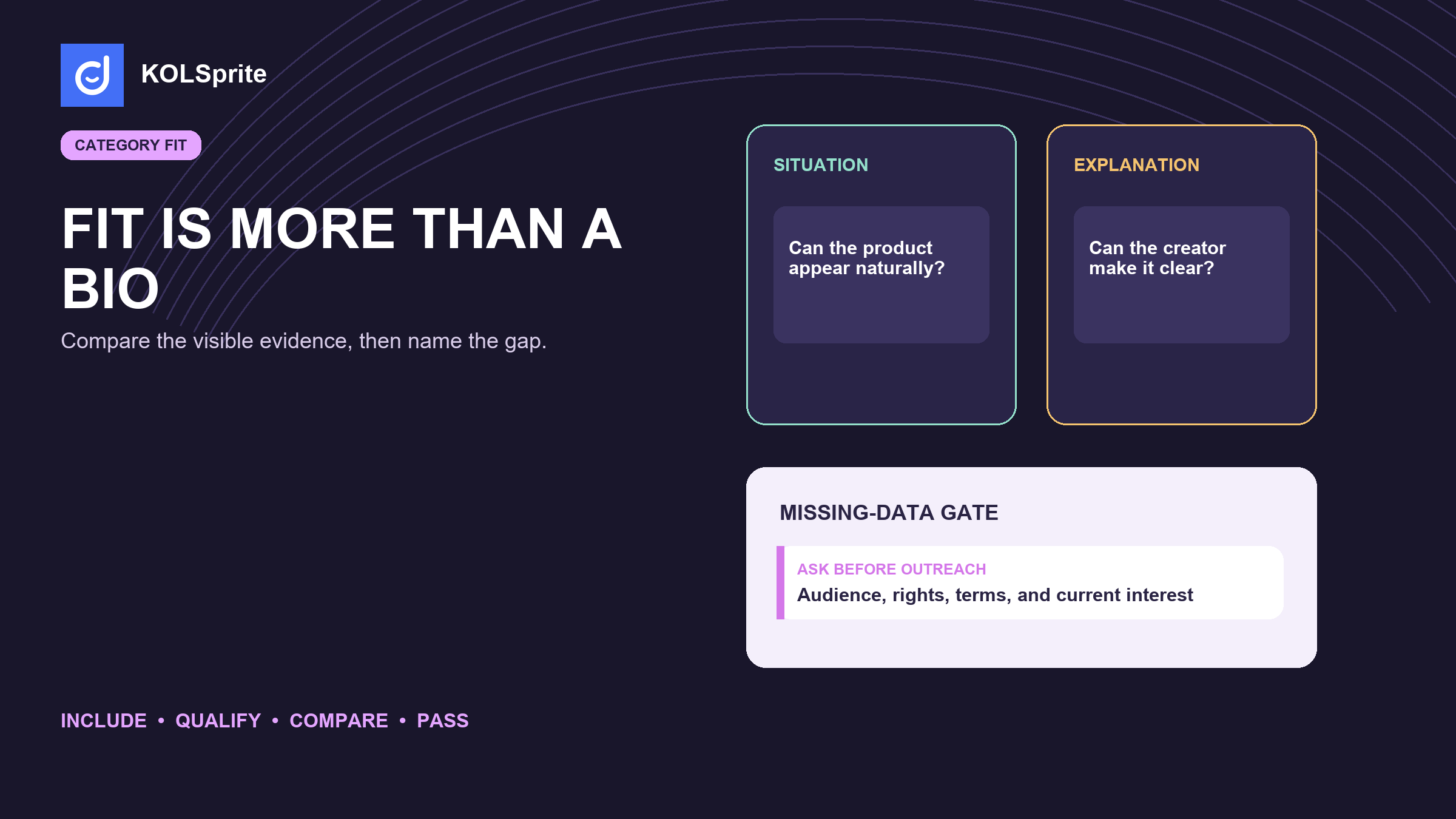
The first lens is situation. Where does the product naturally appear in the creator's visible world? A kitchen organizer fits differently in a meal-prep account than in a generic shopping haul account. The second lens is explanation. Does the creator show how a choice works, or do they mostly react and entertain? The third lens is proof. Can the creator demonstrate the feature that matters without making it look forced? The fourth lens is audience conversation. What questions, corrections, or objections appear around related public content?
None of the lenses proves a future result. Together, they make the shortlist less dependent on taste. They also reveal when the team is trying to force a category match because a creator is available or familiar.
Search-intent source: the dated US English result set included a TikTok Shop creator-vetting guide. Scope: the result helps define the vetting task; it does not verify a creator's fit for your own brief.
| Lens | Public signal to review | Decision it can support | Limit |
|---|---|---|---|
| Situation | Recurring rooms, routines, or purchase moments | Whether the product can appear naturally | Does not reveal every audience need |
| Explanation | How the creator handles comparisons or constraints | Whether a proof-led brief is plausible | Does not promise compliance with a future brief |
| Proof | Visible demonstrations and specific claims | Whether the product has a credible showing path | Does not clear claims or rights |
| Conversation | Public captions and viewer questions | Which objection may need a response | Does not establish audience demographics |
Evidence asset: Category-Fit Evidence Note. Scope: public creator context supports a shortlist decision; it cannot verify audience composition, contract terms, or commercial performance.
Use KOLSprite to compare supported public creator and content context while your team records why a collaboration may fit and what still needs direct confirmation.
Register and claim a three-day trial
Every candidate should have both. The include reason might say, “The creator repeatedly shows renter-friendly organization and explains setup limits in plain language.” The hesitation might say, “Most examples are personal purchases, so product category depth and paid-collaboration interest still need direct confirmation.” That pair is stronger than a score alone because it tells the reviewer where confidence comes from and where it stops.
A category-fit note should also make room for a good pass. A creator can be excellent at their work and still be wrong for this product moment. Passing on that account is not a negative judgment of the creator. It is a way to protect the brief from a mismatch that would make the content less natural for everyone involved.
KOLSprite supports this part of the workflow by helping teams review supported public creator and content context while they are browsing TikTok. You can compare public references and retain a short rationale beside a shortlist. The product does not predict category fit, identify a creator's private audience, or make an approval decision. The team owns those calls.
Many fit decisions fail because the creator is evaluated against a product category, then asked to make a very different piece of content. Bring a draft brief into the review. What needs to be demonstrated? Which buyer doubt needs to be addressed? What cannot be claimed? Which setting would make the product feel honest? If the creator's public work offers a believable path through those constraints, the fit becomes clearer.
There is a useful difference between “could post about this” and “could make this particular explanation feel native.” The first standard generates a larger list. The second produces a better starting group for outreach.
Public work repeatedly supports the product situation and explanation job.
The signal is promising, but a direct question must be answered before outreach moves forward.
Two creators solve the same job differently; review the tradeoff rather than ranking by a single metric.
The creator is credible, but the brief would require an unnatural shift in their public work.
A score can make a list easier to scan, but it can hide the reason behind a recommendation. A 76 does not tell a reviewer whether the strength is the setting, the explanation, the audience conversation, or a purely subjective preference. If you use a score, keep the note beside it. The note should be able to stand on its own when a new teammate asks why the creator was selected.
Scores are also tempting because they make uncertainty disappear. Resist that urge. An unanswered question about claims, audience geography, product access, or rights should stay visible. It does not make the process weak. It makes the next conversation more targeted.
A category-fit note should end in a decision that someone can take this week. That might be a targeted outreach message, a side-by-side review with a peer candidate, a request for more information, or a documented pass. The creator fit questions guide can help frame the public evidence, while the creator brief template connects that evidence to a collaboration discussion.
Those links matter because category fit is not the last stage. It is the bridge between discovery and a specific working relationship. If the bridge has no next action, the research will usually be repeated later by another person.
Join the KOLSprite Discord to compare creator evidence notes, peer comparisons, and the boundaries that keep a shortlist honest.
 +
+
Join the KOLSprite Discord community
One creator can look like a clear match simply because the team has not opened a meaningful alternative. Add a peer candidate with a different content habit: one may teach through comparison, while another shows a routine; one may have a narrow category focus, while another has a broader but more relevant buyer situation. The comparison makes the tradeoff visible.
Do not ask which person is objectively better. Ask which person gives the brief the more believable path to proof. The answer may favor a smaller account with a stronger setting, or it may expose that neither candidate solves the real problem. Both outcomes are useful because they prevent an outreach decision based on a tidy label.
Keep the peer note short. It only needs to say what each candidate makes easier and what each one leaves unresolved.
A creator may have a strong category fit and still need approval from the people who own claims, brand safety, contracts, and product rules. Keeping those decisions separate protects the creator review from becoming a false compliance check. The category note says why a conversation may be worthwhile; it does not authorize the work.
That distinction also helps researchers write more useful notes. They can focus on the visible content evidence instead of trying to infer facts that belong in a separate approval process. Clear boundaries make the next discussion faster and more respectful.
For how to evaluate TikTok creator category fit, put two or three people in one short review. Give each person the same public examples. Ask them to point to the scene that makes the product make sense. Then ask what a viewer would still need to know. This keeps the talk close to the work, not to a broad label.
Use plain notes. “Shows the problem in a real kitchen” is better than “high relevance.” “Needs a direct question about paid work” is better than “medium confidence.” Plain notes travel well when the creator manager, product lead, and brand reviewer do not use the same score card.
KOLSprite can keep the public clips and creator notes beside the category question, so a reviewer can reopen the same evidence later. It cannot certify brand approval or predict campaign performance. Those decisions still need the right owners and current facts.
The same review can surface a clean pass. A creator may make good content but have no natural way to show this product. That is a useful result. It lets the team move on without asking the creator to act outside their normal work. This is the real aim of how to evaluate TikTok creator category fit: a better match, not a bigger list. That is why how to evaluate TikTok creator category fit should stay close to observed work.
Think of a seller who needs help showing a shelf in a small room. One creator posts room makeovers. The posts show tight spaces, real limits, and clear before-and-after shots. A second creator posts shopping finds but rarely shows how an item works at home. Both may sit in a home category. The first has a stronger path for this one brief.
The note can say that in plain words. It can also say what is missing. Perhaps the first creator has not shown a shelf like this. Perhaps the second creator has a strong audience question in the comments. The team can then ask the right question, or compare both people with a third choice.
There is no need to make a grand claim. The public work gives a reason to talk. The direct reply gives facts that public work cannot show. This keeps the review fair to creators and useful to the seller.
Open the posts without the score card at first. What does the viewer learn? Can they see the item in use? Does the creator name a real limit? Does the clip make the choice feel normal for that person's feed? These simple checks often show more than a broad niche tag.
Then add the note. The order matters. It keeps the team from looking for proof of a label it picked before it watched the work. The best category call is not the most polished one. It is the one that a new teammate can read, question, and use.
The best category-fit decisions are rarely dramatic. They are clear enough that a teammate can say, “I see why this creator belongs in the conversation, and I see what we still need to ask.” That is a better standard than perfect certainty. It keeps the team open to new creators while protecting the brief from lazy category assumptions.
Before your next shortlist review, choose one creator selected mainly because of a bio label. Reopen the public work using the four lenses. You may keep the creator. You may also discover that the actual reason for the choice is stronger, weaker, or different from the label you started with.
Continue the research: creator-search proof task · fit questions before collaboration · category-specific proof brief.
Older Article
Track Creator Test Learnings Across Campaigns>>
Latest Articles

As an essential, data-driven toolkit for TikTok influencers and marketers, KOLSprite provides powerful features for effortless creator discovery, trending content identification, and actionable real-time insights.
It empowers users to make smarter decisions and significantly boosts their TikTok business.

 Refer & Earn