 +
+
Amazon product differentiation often starts with a feature list: a new color, a bundle, a stronger material, or a lower price. TikTok can add a different kind of clue. It shows how people frame a product inside a real moment of use. That does not prove a market gap or justify a new listing claim. It can, however, help an Amazon team ask a sharper question about the job a product should make easier. This field note shows how to turn a public use case into a bounded differentiation hypothesis.
Ten-second answer: Observe the use case, name the buyer job, compare it with the current listing story, and test one original hypothesis. Public TikTok context can sharpen the question; product facts and marketplace rules still decide what the listing can promise.
A short video can make a buyer moment visible in a way a product spec cannot. Someone uses an organizer while packing for a trip. Someone compares a lamp in a small room. Someone shows why a cleaning step is annoying. Those scenes can help a team see the job the product is being asked to do.
They do not reveal the whole market. The people who comment or watch may not represent an Amazon audience, and a useful use case may still be too narrow for a listing change. Treat the scene as an observation that needs a separate product and marketplace review.
The job should be written without trend language. Instead of saying a product is aesthetic, say what it helps a buyer do: fit an item in a narrow drawer, avoid a messy transfer, make a routine faster, or choose a size with less risk. Plain wording makes it easier to compare the observation with a current listing.
When the job is unclear, do not force it. A striking clip may only be a visual reference. The goal is not to turn every post into a product insight. It is to notice the cases where the buyer problem is clear enough to test.
Register for KOLSprite and claim a three-day trial to organize the public use-case signal before an Amazon team turns it into a listing test.
Register and claim a three-day trial
Read the listing as a buyer would. Does the title, image set, bullet copy, and product detail page explain the same job? If the listing focuses on material while the public use case centers on setup speed, there may be a communication gap. If the listing already covers the job, the team may not need a new claim at all.
A differentiation hypothesis should be specific: show the product in a standard small-space setup, add a verified size visual, or clarify a care step. It should never be “make the listing more viral.” That is not a buyer job and cannot be responsibly tested.
KOLSprite can help a team collect supported public product, video, caption, creator, and comment context where available. The saved material helps explain why a use case was noticed. It does not establish material performance, compatibility, ratings, or any promise that belongs on an Amazon page.
This separation is especially useful when an idea sounds persuasive. The stronger the public video, the more important it is to ask what the brand can actually verify. The public clip begins the note; the product team decides whether the note can become a claim.
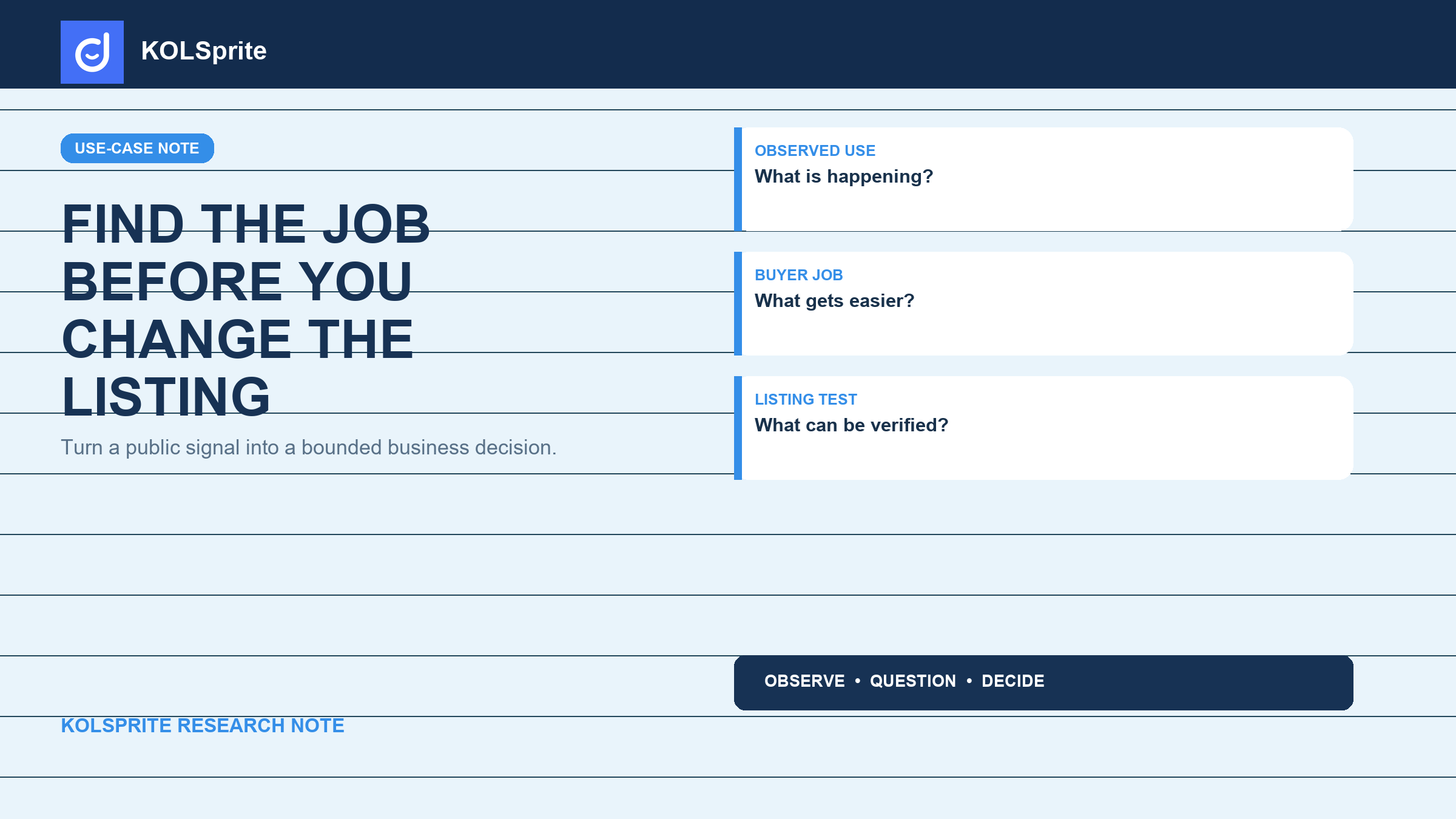
| Observed use | Buyer job hypothesis | Amazon test question |
|---|---|---|
| Product is used during a rushed setup | Reduce a frustrating step | Can the listing show the setup honestly? |
| Creator compares two sizes in a small space | Choose the right fit quickly | Is a verified size comparison missing? |
| Comments ask how it cleans | Reduce maintenance worry | Can the product support a clear care answer? |
Source scope: public video, caption, and comment context supports a product-story hypothesis only. TikTok Creative Center is a platform surface for finding public trend context. The listing team must check current marketplace policy and verified product facts before changing a detail page.
Choose one place to test the hypothesis. It might be an image brief, an A-plus concept, a video outline, or a customer-research question. Changing every part of the listing at once makes the lesson hard to read and encourages a team to credit the most visible change.
The Use-Case Differentiation Note should state what changed and what did not. It should also name the missing proof. That record keeps an Amazon team from treating an appealing creative angle as a finished product strategy.
Join the KOLSprite Discord to compare use-case notes, proof gaps, and practical product-story tests.
 +
+
Join the KOLSprite Discord community
Comments can show the words buyers use when they describe a worry or ask for a detail. That language can improve a research brief. It cannot validate a claim or tell a team that every shopper shares the same concern.
When KOLSprite structures a supported comment area into discussion topics, pain points, use cases, and intent signals, review the original examples before using the wording. The most useful result may be a better question for a product page, not a new sentence for the page itself.
The researcher owns the observed use. The product team owns the factual proof. The listing owner owns the marketplace copy. A clear owner makes the note actionable without pretending that one tool or one video can settle the whole question.
Before changing the listing, ask: what job did we observe, what can our product honestly support, and what one test will tell us more? That is the practical value of Amazon product differentiation using TikTok use cases. It turns a public scene into a bounded next move.
Start with the scene, not the feature. A buyer may be trying to set up a small room, pack a bag, clean a hard-to-reach area, or choose between two sizes. Write that scene in one sentence. Then write the job in plain language. This gives an Amazon team something useful to compare with its listing. It is more concrete than a vague wish to make the page feel fresh.
Next, check the product facts. Can the item actually fit in that space? Does the material support the care claim? Is the comparison accurate for every variant? The answer may be yes, no, or not yet. Each answer is useful. Amazon product differentiation using TikTok use cases works only when the public scene stays separate from the facts that the listing can promise.
Choose one page element to change. A new image may show the setup. A size chart may answer the fit question. A short video may show the cleaning step. Do not change the title, bullet copy, images, and A-plus content all at once. One change gives the team a chance to see whether the use case made the explanation clearer. A long list of changes turns the result into a guess.
Keep an honest limit beside the idea. The use case may be narrow. The video may show a setup that most buyers do not have. The product may be one of several tools in the scene. A limit does not weaken the note. It tells the listing owner what not to imply. That is important when a public clip feels more certain than the available product proof.
KOLSprite can retain the video, caption, creator, and comment context that led to the use-case note. The product team then checks its own facts and decides whether a test belongs on the listing. This handoff is useful because it keeps research from becoming a loose collection of clips. It also keeps the listing from treating a public observation as a verified claim.
At the next review, ask a short set of questions. Did the new page element show the buyer job more clearly? Did it stay within product facts? Did it remove a likely question? Did it create a new one? The goal of Amazon product differentiation using TikTok use cases is not to make a listing look like TikTok. It is to make the product story easier for the right buyer to understand.
Save the result with the original note. A test may show that a small image change helps, that the use case belongs in a video, or that the product cannot support the message at all. Each result is a useful input for the next product review. Over time, these short notes show which buyer jobs are real for the brand and which ones were only good scenes. That is how public video research can support a listing team without taking over its product judgment.
The best notes remain easy to read after a few weeks. They name the observed scene, the product fact, the one change, and the result. That is enough for another person to repeat the check or challenge the conclusion. It also means the team can learn from a failed test without making the failure look like wasted work.
Continue the research: validate Amazon product research on TikTok · keep a rejection-first product shortlist · use AI comment analysis in product research.
Latest Articles

As an essential, data-driven toolkit for TikTok influencers and marketers, KOLSprite provides powerful features for effortless creator discovery, trending content identification, and actionable real-time insights.
It empowers users to make smarter decisions and significantly boosts their TikTok business.

 Refer & Earn