 +
+
Your closest rival may sell the same product, but your hardest competitor may sell a different way to get the job done. A garment steamer competes with another steamer. It also competes with an iron, wrinkle spray, a dry cleaner, a hotel bathroom, and clothes designed not to wrinkle. This guide shows ecommerce teams how to run an indirect competitor analysis with TikTok product and video evidence. You will map the buyer's job, use a real garment-steamer case, reject misleading signals, and finish with a position and content test that direct product comparisons would miss.
Search the job before you search the category. List the different methods buyers use, then compare their tradeoffs, proof burden, and switching moments. The goal is not to call every alternative a competitor. It is to understand what the buyer would do if your product did not exist.
The buyer compares outcomes long before the brand compares features.
A direct competitor sells a similar product to a similar customer. Comparing price, features, reviews, creators, and content can be useful. An indirect competitor solves the same underlying problem through another method. It changes the frame of the purchase.
Shopify's official competitive analysis guide separates direct competitors from indirect competitors that solve the same customer problem in another way. That distinction matters on TikTok because creators often demonstrate a job, not a product category. A "get ready fast" video may place a steamer against an iron without naming a steamer brand at all.
Do not make the map so wide that it loses meaning. A coffee shop is not automatically an indirect competitor to every home appliance. The alternative belongs on the map only if a real buyer could choose it at the same decision moment.
Begin with a sentence such as: "Make a wrinkled outfit presentable in a small space before work or travel." That sentence creates several routes. The buyer can steam, iron, spray, hang the garment in a humid room, send it for professional care, or choose fabric that requires less treatment.
The decision conditions include time, space, garment type, skill, power access, travel rules, finish quality, and willingness to store another device. These conditions explain why a person switches. A traveler may accept a less crisp finish for portability. A person preparing a formal shirt may prefer an iron. A renter may avoid a full board because of storage.
The job statement also keeps the TikTok search honest. If you search only "garment steamer," the result set will mostly show products already shaped like yours. Search the job and its alternatives to see the choice the shopper actually faces.
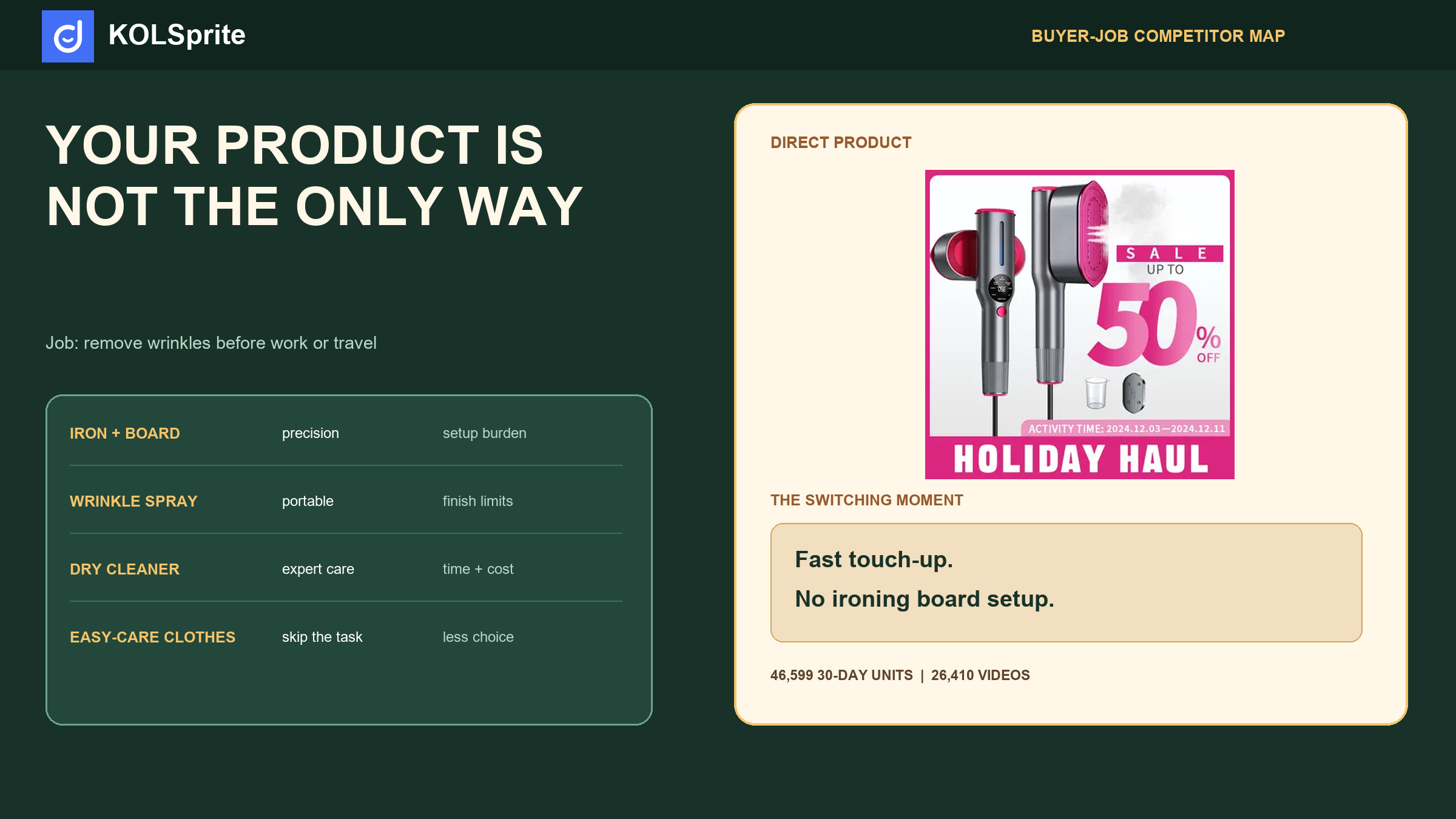
Our US KOLSprite search began with garment steamers. We removed items that did not serve the clothing job. We then opened the linked-video set for one Dr.Flash model. Its public record listed a $34.98 price and a 4.6 rating. It also listed 35,507 reviews, 46,599 units in the latest 30-day field, 5,518 creators, and 26,410 videos. The 30-day growth field read positive 45.79%.
The broad search was noisy. It returned shapewear, home steam cleaners, a facial steamer, a hair tool, and even a hot pot. Those records contained the word "steam" or adjacent language but did not solve the clothing-wrinkle job. Removing them was not cosmetic cleaning. It prevented unrelated product activity from inflating the opportunity.
The exact product videos then made the indirect rival visible. A 13.6-million-play record framed the story around a mother who believed her iron was unbeatable and showed one side of a shirt treated with the steamer. Another high-play record promised time savings. A separate caption used "No iron? No problem." The product was being positioned against ironing as a method, not only against another steamer.
Case scope. We checked US KOLSprite records for product 1729992615540134195 on July 31, 2026. Its page listed 26,410 videos. We kept only the first clips that changed the buyer-job map. One popular caption used health claims with no support in the data we had. We left those claims out.
| Method | Buyer hires it for | Likely strength | Likely tradeoff to verify | Proof your content needs |
|---|---|---|---|---|
| Portable garment steamer | Fast touch-ups with little setup | Portability and ease | Finish quality, water, power, and garment limits | Real setup, heat-up, one garment, and final result |
| Iron and board | Crisp finish and controlled pressure | Precision and familiar method | Space, setup time, and travel burden | Show where steaming is faster, not that ironing is obsolete |
| Wrinkle-release spray | Light correction without an appliance | Small and easy to pack | Drying time, scent, fabric suitability, and finish | Compare on a supported light-wrinkle use case |
| Professional cleaning | Garment care with minimal home work | Expert handling and finish | Cost, travel, and turnaround | Do not compare unless the garment and service job overlap |
| Wrinkle-resistant clothing | Avoid the task | No device or treatment step | Style, fabric feel, price, and choice | Position the steamer for an existing wardrobe |
The map is a hypothesis until the team validates each tradeoff. Product instructions, customer reviews, support records, retailer data, and direct tests should supply the evidence. TikTok shows how creators frame the job and which alternatives enter the story. It does not prove universal performance.
A useful position begins with a moment when the buyer abandons one method. For the steamer case, that moment may be a small apartment with no board, a work trip, a last-minute outfit, or a delicate garment that the product instructions support. "Better than an iron" is too broad. "A faster touch-up when you do not want to set up a board" is specific enough to show and test.
Each alternative needs one switching sentence:
The last two lines build trust. A product is more believable when the brand can state the conditions it does not own.
Start with KOLSprite product search for the direct category. Clean the results and save a few exact products that represent distinct offers. Their product-linked videos reveal recurring problems, settings, proof moments, and named alternatives.
Then run separate searches for the alternative method. Use "travel iron," "wrinkle release spray," or another job-specific phrase. Do not combine incompatible metrics across categories as if they were one market-share table. The goal is qualitative decision evidence: how each method is framed, what proof it needs, and where buyers might switch.
Save the stable product or video ID, market, access date, observed claim, visible proof, buyer situation, and open question. A small set of clean examples is more useful than a large export filled with false matches.
One reviewed steamer caption claimed that the product killed bacteria and dust mites. The available TikTok record did not contain test conditions, a study, or a product document that supported that statement. The correct research action was to flag the claim, not copy it into the new position.
Apply the same rule to speed, safety, fabric compatibility, and travel use. A creator demonstration can show what happened in that instance. A product claim may require controlled testing, instructions, certifications, or legal review. Separate observed action from general promise.
This is where competitive research can prevent bad creative. A rival's viral claim is not a free claim library. It may be the exact risk your brand should avoid.
For the steamer case, a defensible draft position could be: "A compact touch-up tool for shoppers who want to remove everyday wrinkles without setting up an ironing board." It does not say the steamer produces every finish an iron can produce. It owns a clear moment: everyday speed and small-space convenience.
Turn that position into a test:
| Brief field | Completed decision |
|---|---|
| Audience | Apartment residents and travelers who already own clothes that need quick touch-ups |
| Opening | Show the wrinkled outfit and lack of setup time in the first scene |
| Required proof | Fill, heat-up, one supported garment section, and the final result in continuous context |
| Alternative frame | Compare setup burden with a board, not universal finish quality |
| Claim boundary | Follow the product instructions for fabric, heat, and travel use |
| Measure | Qualified questions, saves, product-page action, support issues, and returns tied to expectations |
A finished analysis should change at least one item: the position, product page, creator brief, offer, product roadmap, or decision to leave a segment alone. If the output is a slide with logos and no owner, the team performed collection rather than analysis.
Review the map quarterly or when a new behavior appears. Alternatives can change with season, travel rules, product innovation, or price. Do not assume the rival is fixed.
For direct brand and content comparisons, continue with the TikTok competitor video analysis guide. For the upstream question of whether the product deserves a test at all, use the Amazon product validation workflow. This article owns the space between them: the alternative method the buyer may choose instead.
Write the buyer's job at the top. Ban brand names from that line. Ask the team what the buyer does now. Put each real choice on its own card.
For each card, write one good point and one cost. Keep the words plain. An iron can give a crisp finish. It needs more setup. A spray packs well. It may not give the same result.
Now choose the point where your item helps most. Turn that point into a scene. Show the room, the time limit, the task, and the result. State the limit as well.
Give the test to one owner. Pick one clip, one page, or one ad. Set the fact you want to learn. If the team cannot name the choice that will change, the map is not done.
Define the job without naming your product. Map the methods a real buyer could choose at that moment. TikTok product and video evidence shows how those methods are framed; each tradeoff still needs outside checks. The completed indirect competitor analysis should produce one switching moment, one claim boundary, and one original proof test.
Create a KOLSprite account and claim a three-day trial. Research one direct product, its linked videos, and the alternative methods creators use to frame the job.
Register for a three-day KOLSprite trial
Bring the buyer job, the methods on your map, and the switching moment you want to own. Other sellers can help spot a missing substitute or an overbroad claim.
 +
+
Discuss the competitor map on Discord
Latest Articles

As an essential, data-driven toolkit for TikTok influencers and marketers, KOLSprite provides powerful features for effortless creator discovery, trending content identification, and actionable real-time insights.
It empowers users to make smarter decisions and significantly boosts their TikTok business.
 Refer & Earn