 +
+
When shoppers name another brand below a TikTok video, they are often revealing the comparison your content failed to answer. Some are asking whether your product is compatible. Some are testing price, durability, size, status, or trust. Others are joking, repeating a hashtag, or defending a favorite brand. This guide shows product and content teams how to review competitor mentions in customer comments without counting every name as demand. You will build a comparison-intent map, use a tumbler case to define the right questions, and turn the result into a product-page or creative test.
Count the decision behind the name, not the name alone. Group comments by comparison job, verify whether the product can answer that job, and choose one proof change. A competitor mention becomes useful only when it changes what the team shows, says, tests, or fixes.
A named rival is often a missing sentence in your product story.
A dashboard that says "Stanley appeared 184 times" looks useful. It is not yet a decision. The word could appear in a direct comparison, a joke, a creator tag, a correction, a question about cup holders, or a comment that says the two products are nothing alike. The same total can describe very different buyer concerns.
The unit of analysis comes first. One comment becomes one record, and each record gets a buyer job. Preserve the original wording for review. Do not publish usernames or personal details in the working deck. Remove duplicates, obvious spam, creator replies that merely repeat the name, and comments that have no product meaning.
TikTok's official description of Comment Insights also treats comments as themes, questions, positive discussion, and audience suggestions rather than one undifferentiated volume. KOLSprite's AI Comment Analysis can help a seller summarize similar patterns while browsing, but a human still needs to decide whether the theme is material and whether the product can support the response.
| Intent bucket | Typical shopper meaning | Useful response | Bad response |
|---|---|---|---|
| Feature comparison | "Does this leak like my other cup?" | Show the supported leak-resistance condition | Claim "100% leakproof" without a valid basis |
| Compatibility | "Does it fit the same cup holder or lid?" | Show dimensions and the supported fit | Say "fits everything" |
| Value comparison | "Why is this cheaper or more expensive?" | Explain material, capacity, included parts, and warranty | Attack the other brand |
| Switching signal | "I want an alternative because mine spills" | Test the exact problem that caused switching | Treat one complaint as market-wide proof |
| Identity or status | "It looks like a Stanley" | Clarify the product's own use case and design | Build the whole message around imitation |
| Noise | Memes, fan arguments, unrelated tags | Exclude from the decision set | Count it as purchase intent |
These buckets are not sentiment labels. A negative comment can contain a useful feature question. A positive comment can still reveal a compatibility concern. Keep sentiment as a secondary field and comparison intent as the working field.
We searched KOLSprite's US TikTok Shop product records for insulated tumblers and followed one exact 40-ounce Meoky product into its linked videos. The captured product record showed a price of $42.43, a 4.8 rating, 63,772 reviews, 77,541 units in the latest 30-day field, 692 linked creators, and 1,311 linked videos. Those values are platform records, not audited sales attribution.
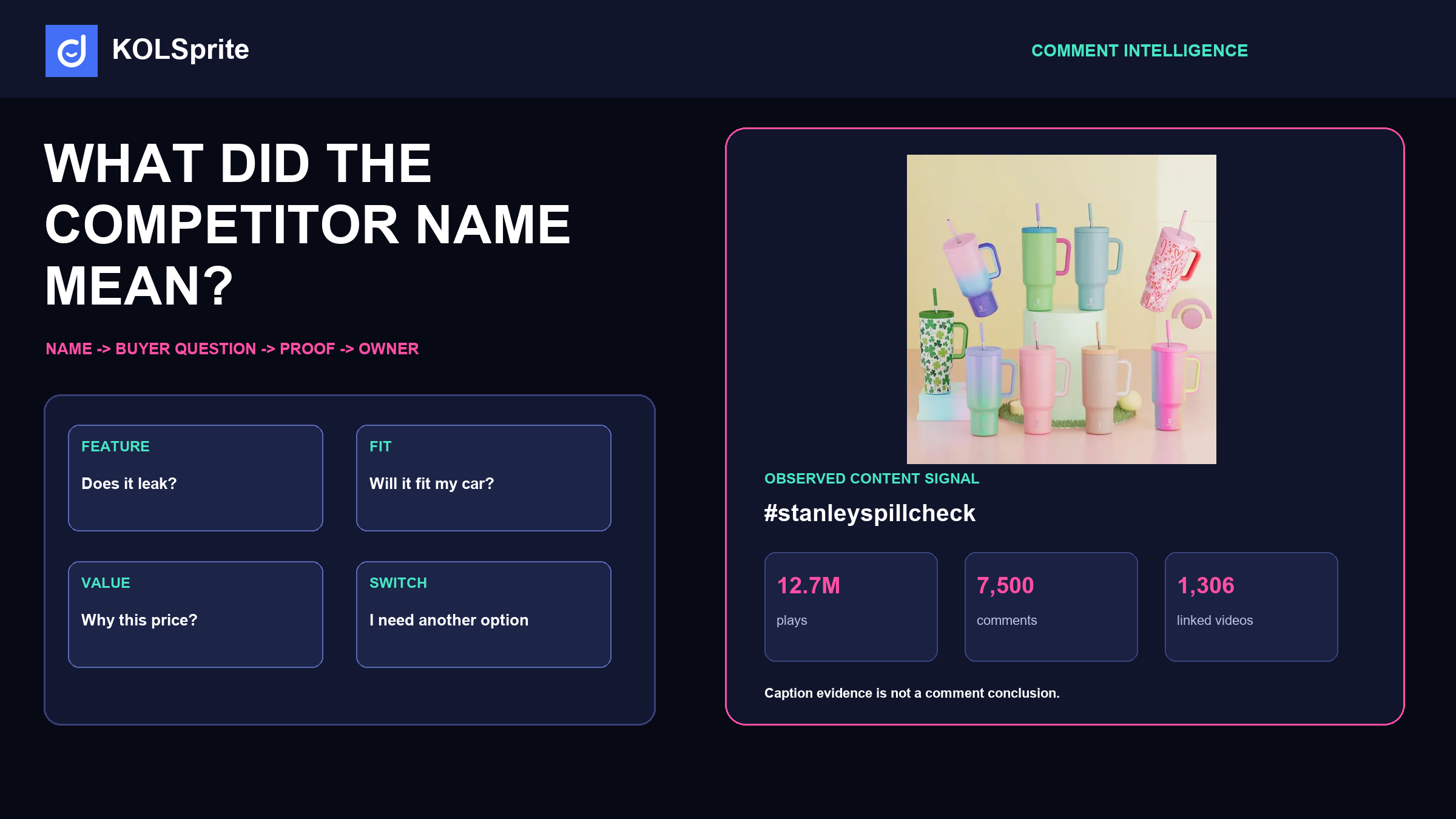
The first product-linked video records made spill resistance a major visible proof. One recorded about 20 million plays and 1.9 million likes. Another recorded about 12.7 million plays, 517,300 likes, and 7,500 comments. Its caption included both #stanleyspillcheck and #stanleycup. Other high-play records used Stanley-related hashtags as well.
This observation tells us that the competitor frame already exists in the content environment. It does not tell us what the 7,500 comments said. KOLSprite's product and video records supplied the product, performance fields, and caption evidence. A comment review must still open the actual comments or use the AI Comment Analysis feature on the source video before any audience claim is made.
Research note. KOLSprite US product and exact product-linked video records for product ID 1729389874815799694, accessed July 31, 2026. The source set reported 1,306 linked videos; this case used the first decision-useful high-play records. Competitor names were observed in creator captions and hashtags. No reader-comment result has been invented.
Open the exact source video while signed into TikTok, then run KOLSprite's AI Comment Analysis from the browser workflow. Keep the video ID, creator handle, product ID, access date, number of comments actually available to the tool, language, and any filters used. The public article does not need the raw cleaning log. The internal research card does.
Use the AI summary to locate themes, not to skip source review. Read examples from every material bucket. Check whether sarcasm, slang, translation, or a creator reply changed the meaning. If a competitor name appears in a caption, make sure caption text was not counted as a customer comment.
Then create a compact decision table. The rows below show how the tumbler team should act if those patterns appear. They are a completed operating map, not a claim that the reviewed video's audience produced each line.
| If the comment pattern appears | Question to verify | Evidence to build | Business action |
|---|---|---|---|
| "Does it really not spill?" | Under which lid position and movement does the claim hold? | Continuous normal-use spill test with stated conditions | Update video and product-page claim limits |
| "Will it fit my car cup holder?" | Which base diameter and common holders are supported? | Dimension card plus named vehicle examples tested by the team | Add compatibility guidance |
| "Stanley has more colors" | Is choice a purchase barrier or fan preference? | Color-demand tally linked to inventory economics | Test one color expansion, not a full range |
| "This is just a copy" | What original use case can the product own? | Distinct feature, setting, or service proof | Reposition instead of arguing |
| "Mine leaked after a week" | Is this setup, wear, cleaning, or product failure? | Support investigation and durability check | Escalate to product before making more content |
Comment summaries are useful because thousands of short messages are hard to scan. They are dangerous when the summary removes the buyer's exact comparison. "Concern about quality" is too broad. "Lid starts leaking after dishwasher use" gives product, support, and content teams something they can test.
For every major theme, keep two or three short, anonymized examples in the internal card. Record how often the theme appeared in the reviewed set, but avoid turning a partial comment set into a population claim. If the available set is incomplete, label it. If comments are sorted by relevance rather than time, record that too.
Translation needs a second check. A translated competitor name may be correct while the surrounding tone is wrong. Read the original when the decision carries product, legal, or reputation risk. AI should reduce reading work, not remove judgment.
Not every comparison belongs to social media. Assign each theme to the team that can change the outcome.
This prevents the community manager from writing a clever reply to a problem the business should solve. It also gives creators a better brief. Instead of asking them to "mention that we are better," the team can ask them to show one verified difference under normal conditions.
Suppose the comment review confirms that cup-holder fit is the most repeated actionable comparison. The first test should not also change price, color, lid claim, creator, and offer. Build a dimension-led proof sequence. Show the base measurement, two tested holders, how the handle affects placement, and any known limits. Put the same dimension near the Amazon or Shopify product information.
Measure qualified actions: product-page visits, compatibility questions, returns tied to fit, support contacts, and conversion for the tested variant. A fall in generic engagement is acceptable if the new content helps the right shopper decide. Keep a pre-change and post-change cohort large enough to read.
If the comments instead point to actual leakage after normal use, stop the creative test and investigate the product. A product failure wrapped in stronger proof becomes a larger return and reputation problem.
Start in product search to identify the exact item and its market context. Follow the product into video search so the comment review stays attached to the right source. Then use AI Comment Analysis on the selected TikTok page to group questions, competitor references, sentiment, and buyer language.
The sequence matters. A random high-play video may discuss a different size, lid, or product generation. Stable product and video IDs keep the evidence traceable. Save only the decision-ready fields in the public brief. Keep raw comments and personal details out of the article.
For a broader method on turning comment themes into product and content decisions, use the AI Comment Analysis guide. If the theme reveals an opportunity to rewrite a creator brief, continue with the TikTok UGC strategy guide.
Repeat the same comment method after the new proof has had time to reach a useful audience. Do not expect the competitor name to disappear. A healthy comparison can remain while the question changes. "Does it fit?" may become "Which color should I get?" That is evidence that the first uncertainty was reduced, not proof that the product won the market.
Track the theme, source video, date, available comment count, content change, product change, owner, and next decision. The record should show what the team learned even when the test fails.
Pick one video and one product. Save the video ID and date. Run the comment tool. Read the first set of themes. Then read real lines from the top theme.
Write the rival name on a card. Under it, write the question buyers ask. Do not write "brand buzz." Use words a shopper would use, such as "Will it fit?" or "Why does this leak?"
Mark the question as proof, product, price, care, or noise. Pick the owner. Add one fact that is still not known. If the fact is key, stop the reply and ask for it.
End with one next step. Show the fit. Test the lid. Fix the guide. Ask support. Or drop the theme as noise. A short pass is useful when it ends with a clear act.
Use the competitor name to locate a buyer question. Verify the question in real comments, preserve a small source trail, and assign the theme to the team that can change it. Then test one truthful proof or product fix. This makes competitor mentions in customer comments a source of better decisions, not a vanity count or a reason to attack another brand.
Create a KOLSprite account and claim a three-day trial. Connect an exact product and video with AI Comment Analysis, then assign one comparison theme to the right team.
Register for a three-day KOLSprite trial
Share an anonymized comment theme, the evidence behind it, and the proposed owner. The group can help separate a content gap from a product problem.
 +
+
Comment action map discussion on Discord
Latest Articles

As an essential, data-driven toolkit for TikTok influencers and marketers, KOLSprite provides powerful features for effortless creator discovery, trending content identification, and actionable real-time insights.
It empowers users to make smarter decisions and significantly boosts their TikTok business.
 Refer & Earn