 +
+
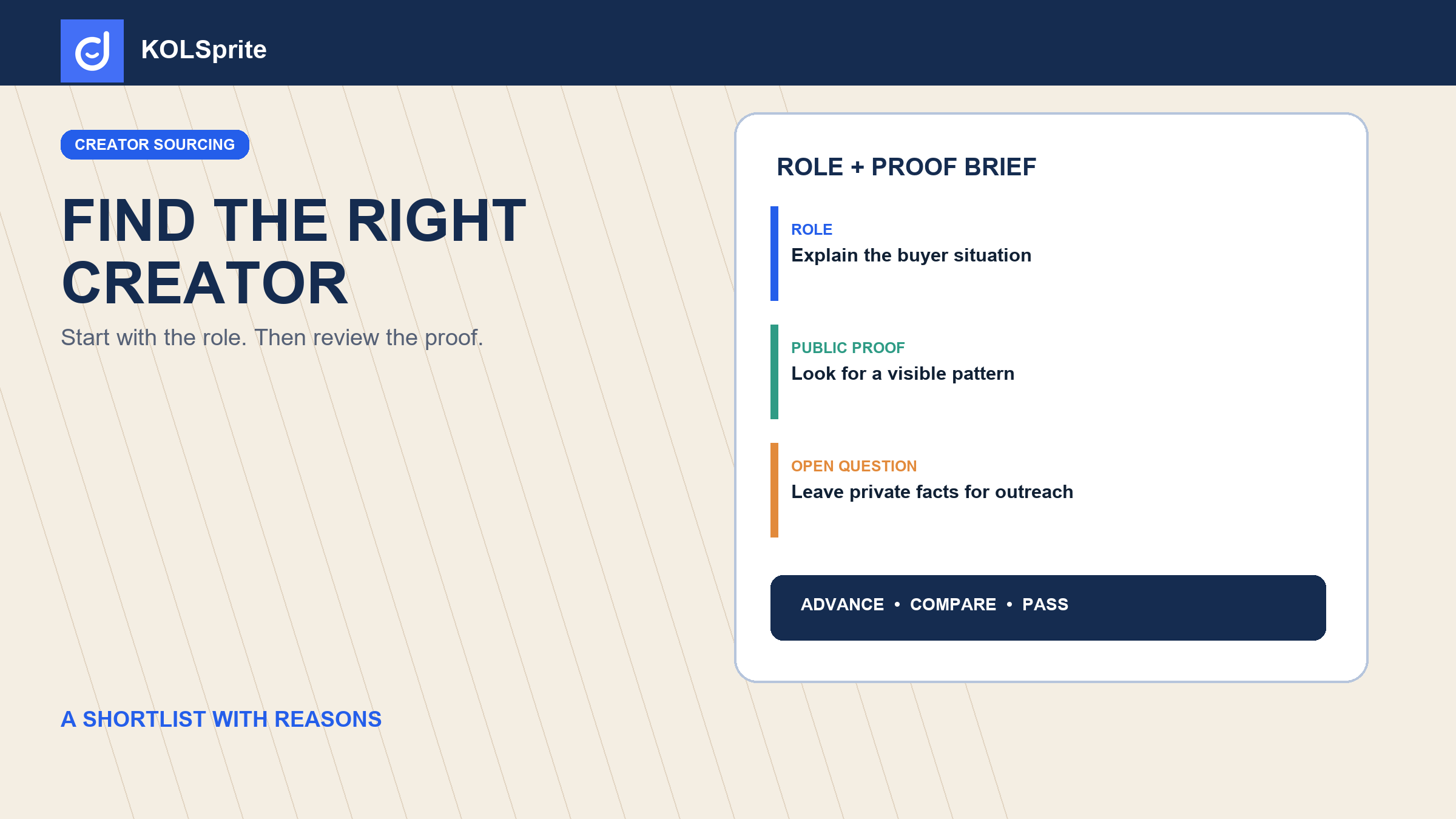
Teams that need to find TikTok influencers often begin with a long search and a vague hope: someone will look right for the product. That approach produces a list, but not a decision. A stronger starting point is to define the job the creator must do, the public proof you need to see, and the question that still has to be asked. This article gives seller and affiliate teams a Role-and-Proof Sourcing Brief they can use before they collect names.
Ten-second answer: Do not search for the biggest creator first. Search for a creator role, review the public proof that role requires, and label every unknown before outreach. The output is a shortlist that someone else can review without asking why each name was saved.
The phrase find TikTok influencers hides several different jobs. A launch team may need a person who can show a product in use. An affiliate manager may need a person who already explains a narrow category well. A brand team may need a reliable source of creative learning, even when the person is not a near-term partner. Those are different searches. They call for different proof, different outreach, and different reasons to pass.
When the job is not written down, a team usually substitutes easy signals. It sorts by follower count, saves a few polished videos, and treats a familiar niche label as evidence of fit. The result can feel efficient in a meeting, yet it leaves the next person with no way to tell whether a saved account was meant to demonstrate the product, reach a buyer type, test an angle, or simply inspire a brief.
Search results for this query currently lean toward creator databases and search tools. That is useful for discovery, but it can encourage a false belief that the tool is the method. A database can return names. It cannot decide what a creator must prove for your offer. Put that decision first, then choose the tool that makes the public review easier.
Search-intent source: the dated US English result set included creator-search results on Collabstr. Scope: this confirms the type of pages searchers encounter, not the quality or fit of any creator.
A role is a one-sentence description of the contribution you need. It is not an audience label. “Fitness creator” is a category. “A creator who can make a skeptical buyer understand how a compact treadmill fits into a small apartment” is a role. The second version tells the researcher what to look for in the public work: space constraints, a clear demonstration, an objection answered in plain language, and an audience response that is relevant to the product question.
Good roles are specific enough to change the review, but narrow enough to be useful. They explain the commercial problem without pretending that one video can prove future sales. A role can be about demonstration, comparison, trust, education, or a customer objection. It can also be a research role: find creators whose public posts reveal how people describe the problem, even if they are not candidates for outreach.
| Weak search note | Role-and-proof version | What changes in review |
|---|---|---|
| Find home fitness influencers | Find creators who show small-space workout setups and explain setup limits | Review demonstrations and buyer questions, not just a fitness label |
| Find TikTok Shop affiliates | Find creators who turn a product comparison into a clear next step | Look for explanation quality and disclosure context |
| Find skincare creators | Find creators who explain a routine change without making unsupported promises | Review claim language and proof boundaries |
| Find viral creators | Find creators whose recurring format addresses the launch question | Compare repeatable framing rather than one spike |
Evidence asset: Role-and-Proof Sourcing Brief comparison. Scope: this is a human review framework, not a prediction of reach, sales, audience identity, or contract fit.
Use KOLSprite to review supported public creator and content context while your team records why a creator belongs in the next outreach list.
Register and claim a three-day trial
The first pass is about relevance. Open several recent public posts and ask whether the category appears in the creator's actual work, not only in a bio or one sponsored video. Look for the situation in which the product makes sense. If the product is useful because it saves time, can the creator make that time pressure visible? If the product solves a setup problem, can they show the setup without burying the point under unrelated trends?
The second pass is about explanation. A creator does not need to sound like a product manual. In fact, the best evidence may be a short moment where the creator names a limitation, compares two options, or responds to a practical question in comments. The point is not to grade their style. It is to see whether their public work gives you evidence that the role is plausible.
The third pass is about uncertainty. Public content cannot confirm a creator's current rates, brand interest, audience geography, rights availability, or willingness to follow a brief. Record those as questions. Teams make better outreach choices when the shortlist separates what was observed from what still needs a direct answer.
A useful brief can fit on one page. Start with the role, then add three proof prompts: what should be visible in public content, what should be heard in the creator's explanation, and what question should the comments or captions help you explore. Add a final line that names the unresolved fact. That line is not a weakness. It stops the team from treating a public profile as a completed diligence file.
What must this creator help the team demonstrate, learn, or test?
Which recurring scenes, explanations, or buyer questions would make the role believable?
Which fact needs direct outreach, a contract review, or another system?
Contact, compare with a peer, watch for a week, or pass with a reason.
KOLSprite is useful at this point because the review happens close to the TikTok browsing surface. A researcher can compare supported public creator and video context, keep content references with the shortlist, and capture the reason a profile is relevant while it is still visible. That helps with the research handoff. It does not prove future results or replace direct verification.
For a related decision, use the creator search decision guide to define the research task, then use the creator brief template when a candidate moves into a proposed collaboration. Those pages serve different moments: discovery, then communication.
A shortlist is a research output. It says, “These are the accounts worth a closer conversation, and this is why.” Approval is a separate decision that can involve claims, product safety, rights, fees, audience details, and campaign timing. Combining the two creates a quiet pressure to defend every saved name. That pressure makes people overlook weak evidence because the list already feels like a commitment.
Give each candidate one of four outcomes: advance, compare, hold, or pass. Advance means the public proof supports the role and the unknowns are suitable for outreach. Compare means the account has a useful signal but needs a peer benchmark. Hold means the role may be right but the public record is too thin or too old. Pass means the account may be good, but not for this job. A documented pass reason is valuable future research; it keeps the same weak fit from coming back as a new find next week.
Outreach should continue the research, not pretend that it is finished. Refer to the role in plain terms. Say what you noticed in the public content without flattering the creator with generic praise. Then ask the one or two questions that public data could not answer. For example, can they show the product in a small-space routine? Are they open to a comparison format? What does their normal process look like for reviewing a product claim?
This makes the message easier to answer and easier for your team to assess. It also makes a no useful. A creator who is not interested in the format may still reveal that the role needs a different kind of partner. Treat that response as a sourcing signal, not as a failed spreadsheet row.
Join the KOLSprite Discord to discuss creator research notes, open questions, and the reasons a prospect should advance, wait, or pass.
 +
+
Join the KOLSprite Discord community
Search terms still matter, but they should grow from the role. Combine the product situation with the content behavior you need to see: small-space setup, comparison, routine explanation, repair, budget test, or gift decision. Then widen only when the review shows a real adjacent pattern. This makes discovery more deliberate than entering a broad niche term and hoping the first page of profiles supplies the answer.
As the list grows, note which words found useful evidence and which only found familiar-looking accounts. That record improves the next search because it distinguishes a productive phrase from a popular but empty label.
Set aside twenty minutes for the first review. One person reads the role. Another person opens the public posts. Together, they decide whether each name has enough visible proof to stay. This is not a vote on who is most popular. It is a check on whether the account can help with the job in the brief.
In that meeting, KOLSprite can keep the supported public references tied to the source row rather than leaving them in a separate chat or browser tab. The team still decides who to contact. The tool simply makes the public review easier to reopen.
Keep the notes short. A strong row has one observed scene, one reason it matters, and one open question. A weak row has a string of vague praise. That contrast makes it easier to clean the list before anyone writes outreach.
To find TikTok influencers well, do not aim for a pile of profiles. Aim for a few clear reasons to start a conversation. The role tells you what matters. Public proof tells you why the account entered the list. The open question tells you what outreach has to resolve. That structure gives creator research a useful end point: a human decision with evidence, limits, and a next action.
Before your next search, review one existing shortlist and remove any name that has no role, no observed proof, or no recorded unknown. The list will get shorter. It will also become more usable, which is usually the better trade.
Continue the research: creator-search proof workflow · defensible creator shortlist · creator brief with proof requirements.
Latest Articles

As an essential, data-driven toolkit for TikTok influencers and marketers, KOLSprite provides powerful features for effortless creator discovery, trending content identification, and actionable real-time insights.
It empowers users to make smarter decisions and significantly boosts their TikTok business.

 Refer & Earn