 +
+
Before you pay a creator to feature a car vacuum, can your own camera show the reason to buy it? An honest pilot uses one measured pile of debris in a car-seat seam, a clear starting frame, and one continuous cleaning pass. If viewers cannot see the change, the product claim or the shot needs work. A sales screenshot cannot make that proof for you. This article leaves you with a shootable brief and a pass-or-fail review rule.
Fund a creator test only after the seat-to-clean-seat change is clear on camera and the proposed claim stays within what the clip shows. The finished brief below gives a creator a scene to shoot, not a vague request for an enthusiastic review. It also gives your team a pass or fail rule before fees are committed.
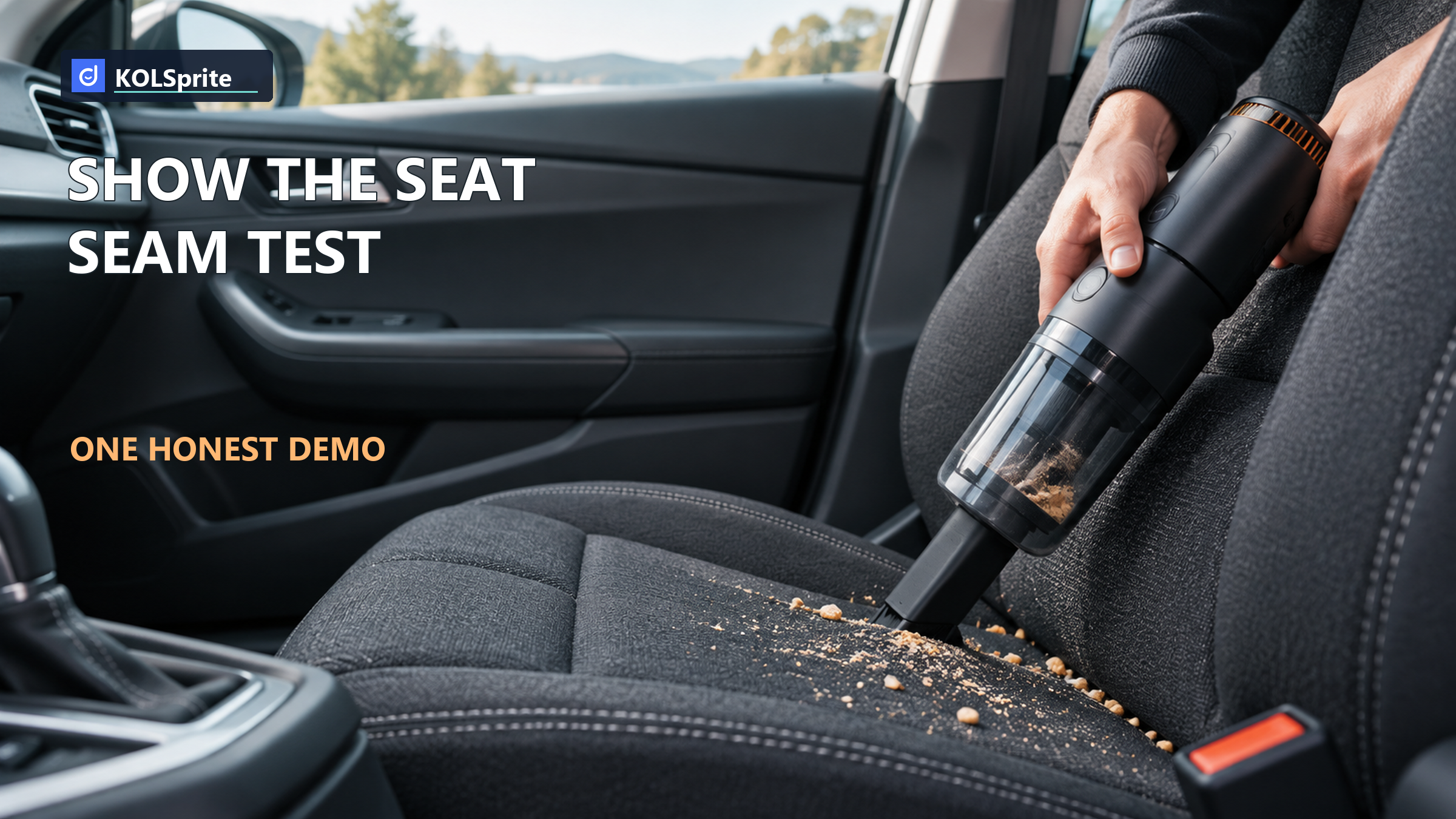
The brief begins on the passenger seat, at one seam between the cushion and the seat back. A small, measured pile of dry crumbs stays in focus in the opening frame. One fixed camera angle then shows a continuous cleaning attempt. The seat seam is the claim: it reveals whether the nozzle can reach a common place where a full-size vacuum is awkward. A cut between the dirty and clean frames would hide the result the buyer needs to judge.
Do not choose debris because it looks dramatic if it is unlike what a buyer would clean. Avoid adding a large pile that requires several hidden passes. Write down what you used and how much. That lets a second person repeat the scene and judge whether the camera helped or hid the result. If the seat fabric traps a few bits, show them. A truthful residue is better than a cut that makes a weak product look perfect.
Keep the first trial owned by the brand. You can shoot it with a phone and review it before a creator receives a brief. That small test tells you whether the product has a visible action worth paying someone else to film. If the clip fails, the next spend should be on a better setup, a narrower claim, or a different product. Creator fees should not be the cost of learning that the item is hard to show.
The product may have other merits, such as a small size or a convenient storage spot. Test those separately if they matter to the buyer. Do not pile them into the first scene. One clean visual claim gives the viewer a fair chance to understand what the item can do.
A US KOLSprite product result checked on October 8, 2026, showed a SEESE cordless car vacuum at $45.37, with 7,330 reported units over 30 days. The result linked one video and one creator. Other nearby results included vacuums and pet products that were not the same item. The exact listing matters; a handheld vacuum for a different job is not a fair substitute for this scene.
One SEESE cordless car-vacuum result showed $45.37, 7,330 reported 30-day units, one linked video, and one linked creator. The observed fields do not show what caused sales or how many creators could make a useful demo.
Source: KOLSprite US product research, checked October 8, 2026; one exact listing from a small result set. TikTok Shop's shoppable-video guidance informs the demonstration standard, not the observed sales. This record cannot explain what drove those orders.
The numbers justify a closer look at a specific product, not an outreach budget. A linked-video field is a narrow public clue. It does not count every clip on the platform, and it does not tell you whether the linked clip proves suction. Watch the footage and inspect the exact product format. If the nozzle, power, or included parts differ from your own item, the comparison may teach you little about your demo.
For a wider method of choosing a proof scene, read the product video proof-shot guide. Here, the car-seat seam gives you a concrete test to run before you ask a creator to make a claim for you.
Register for KOLSprite and claim a three-day trial of the web product to inspect the public car-vacuum record. Run the seat-seam proof test with your own unit. MCP access is sold separately.
Register and claim a three-day trial
A weak brief says, "Show that this vacuum has powerful suction and makes any car spotless." The creator cannot prove "any car" in one clip. "Powerful" has no agreed test, and "spotless" invites a cut between a dirty seat and a clean one. A viewer may see motion without seeing the product do the work. That is a poor use of a paid shoot.
Rewrite the claim as a scene: "Show the vacuum removing a fixed amount of dry crumbs from one seat seam in one visible pass." This does not promise a result for every car. It asks for a shot that a viewer can judge. If the product takes two passes, film two passes and say so. If a brush attachment is needed, keep that attachment in frame from the start.
Place a camera where the debris, nozzle, and cleaned area can all stay visible. Use the same lighting in the before and after frames. Do not swap a dirty seat for a clean one. Avoid a tight crop that hides where the nozzle went. The best angle is the one that makes the action easy to verify, even if it looks less polished.
Keep sound as support, not proof. A loud motor does not show cleaning performance. A hand moving quickly across the seat does not show it either. Let the visible change carry the claim. If you later add captions, have them describe what the clip actually shows rather than invent a suction rating or a universal outcome.
Once your owned test works, send a short brief with the same physical task. The creator may choose a natural voice and setting, but the evidence beats should stay intact. State what product version and attachment they will receive. Ask them to disclose any change to the setup before filming. This saves both sides from a finished video that cannot support the agreed claim.
Opening frame: Show the car seat and the seam with the fixed debris visible. Hold long enough for a viewer to see the starting state.
Product frame: Show the vacuum and the attachment to be used. Keep the product identity clear without spending the whole clip on packaging.
Action frame: Film the nozzle entering the seam and making one continuous pass. Keep the debris and contact point in view.
Result frame: Return to the same angle and light. Show the cleaned seam, including any debris left behind.
Claim boundary: Describe only what that filmed seat, debris, attachment, and number of passes show.
Put the amount of debris in the brief as a physical measure your team can repeat, such as one level teaspoon of dry crumbs. That is a suggested test setup, not a claim about the SEESE listing. The exact measure matters less than making it fixed and visible. If your own vacuum struggles with crumbs but handles dust, change the scene and claim before a creator shoots. Do not change the debris in editing to make the result look stronger.
Ask for the raw continuous action shot along with the edited clip. That gives your reviewer a way to check cuts. It also lets the creator keep the short final video lively while preserving the proof. Agree on any reshoot terms, usage rights, and payment before filming. These are part of a workable creator brief, even though public product research cannot settle them.
Bring a specific proof-shot question to the KOLSprite seller community.
 +
+
Use four questions at review. Is the starting debris clear? Can you follow the nozzle through the whole pass? Does the result use the same seat and angle? Does every spoken or written claim fit the visible result? A clip passes only if the answer to all four is yes. A pleasing edit with an unclear starting frame fails the proof test.
Give the reviewer room to say "unclear." The team may need a closer starting frame, brighter light, or a slower pass. Those changes improve legibility without changing the product result. If the vacuum leaves debris, decide whether a two-pass claim is still useful. If it cannot make a meaningful change on the chosen seat, stop and reconsider the claim. Paying for more versions of the same weak scene will not solve it.
Keep a still from the start and a still from the result beside the review note. Write down the debris, attachment, surface, and pass count. This small record protects the brief from drifting into a broad performance promise. It also tells the next creator what the accepted scene actually was.
Compare this with another product where fit must be shown on camera, such as the magnetic car phone mount compatibility test. The shared lesson is the review habit: make the claimed benefit visible in a scene a buyer can recognize.
Fund a creator only when the owned clip passes and the claim can travel into someone else's car without becoming misleading. In outreach, share the scene, the product version, and the claim boundary. Ask whether the creator can shoot an honest version with their own seat and conditions. Their car may differ. That difference can make the content more useful if the brief allows the result to remain truthful.
Use KOLSprite product research to locate the exact SEESE car-vacuum listing and inspect its limited visible video and creator fields. Exclude unrelated vacuum formats before interpreting the result. The output is a scoped listing observation that helps you pick an item to inspect. Then run the owned seat-seam test. The product record starts the question; the filmed action decides whether this claim deserves a creator brief.
One linked creator is not a count of the full creator market. The reported sales field does not show whether any video drove those orders. KOLSprite cannot validate your vacuum's suction, the creator's shoot, or the rights for a finished clip. Keep the source date with the observation and do not turn the public fields into a promise about campaign results.
If the test passes, send the final scene brief with the offer and review standard. The creator brief template can help turn the shot list into an assignment. If the test fails, your decision is still useful: revise the claim or defer paid outreach until the seat seam tells a story the camera can support.
Latest Articles

As an essential, data-driven toolkit for TikTok influencers and marketers, KOLSprite provides powerful features for effortless creator discovery, trending content identification, and actionable real-time insights.
It empowers users to make smarter decisions and significantly boosts their TikTok business.

 Refer & Earn